

Amsterdam started as a small fishing settlement on a dam in a river and grew, in a few hundred years, into one of the richest cities in the world. Its history is written in its canals, its gabled houses and its tolerant, trading character. This short history of Amsterdam takes you from the first dam to the city of today, with the places where you can still see each period.
Timeline: the history of Amsterdam at a glance
| Period | What happened |
|---|---|
| Around 1270 | A dam is built in the Amstel river; the settlement becomes known as Amstelredamme. |
| 1275 | Count Floris V grants toll freedom to the people of Amstelredamme, the first written mention of the city. |
| Around 1300 | Amsterdam receives city rights. |
| 1345 | The Miracle of Amsterdam makes the city a pilgrimage site. |
| 1452 | A great fire destroys much of the wooden city; brick gradually replaces wood. |
| 1578 | Amsterdam joins the Dutch Revolt against Spanish rule. |
| 1602 | The Dutch East India Company (VOC) is founded. |
| From 1613 | Construction of the canal ring begins. |
| 1648 to 1665 | The new city hall, today the Royal Palace, is built on Dam Square. |
| 1806 to 1810 | Louis Napoleon rules the Kingdom of Holland; the city hall becomes a royal palace. |
| 1876 | The North Sea Canal opens, reviving the port. |
| 1889 | Amsterdam Centraal Station opens. |
| 1940 to 1945 | German occupation; most of the city’s Jewish population is deported and murdered. |
| 2010 | The 17th-century canal ring is added to the UNESCO World Heritage list. |
The beginning: a dam in the Amstel
In the 13th century, farmers and fishermen lived on the banks of the Amstel river where it met the IJ, a large inlet of the sea. Around 1270 they built a dam to protect their land from flooding. The settlement next to it took its name from the dam, Amstelredamme, and the place where it stood is still the heart of the city: Dam Square. Read more about the river in our guide to the Amstel.
In 1275 Count Floris V of Holland granted the people of Amstelredamme freedom from tolls on his roads and waterways, the oldest surviving document that mentions the city. Around 1300 Amsterdam received city rights, and its position on the water made it a natural trading post for beer, grain and herring.
A medieval trading town
In 1345 a reported miracle involving a communion wafer turned Amsterdam into a place of pilgrimage, and the yearly Silent Walk (Stille Omgang) through the city still commemorates it. The town was mostly built of wood until two great fires in the 15th century, after which the city began requiring brick walls and tiled roofs. One of the few surviving wooden houses stands in the Begijnhof.
The city grew rich on trade around the Baltic Sea. Its oldest canals, such as the Oudezijds Voorburgwal and the Singel, began as defensive moats around the medieval town.
The Golden Age
The 17th century was Amsterdam’s Golden Age. After the fall of Antwerp to Spain in 1585, merchants, craftsmen and refugees moved north, bringing money and skills. In 1602 the Dutch East India Company (VOC) was founded, often called the first multinational company, trading spices, textiles and porcelain across Asia. You can see a replica of a VOC ship at the Maritime Museum: read more about the VOC ship in Amsterdam.
To house its growing population, the city built the famous canal ring from 1613: the Herengracht, Keizersgracht and Prinsengracht, lined with grand merchant houses. Our article on the canal belt explains how it was planned. The new city hall on Dam Square, now the Royal Palace, was one of the largest buildings in Europe at the time. It was also the age of Rembrandt, Vermeer and Frans Hals, whose work you can see in the Rijksmuseum.
Decline, Napoleon and a new kingdom
In the 18th century Amsterdam lost its lead to London and Paris. In 1806 Napoleon made his brother Louis king of the new Kingdom of Holland, and the city hall on Dam Square became a royal palace. After Napoleon’s defeat the Netherlands became an independent kingdom, with Amsterdam as its capital.
The 19th century: a modern city
The opening of the North Sea Canal in 1876 gave ships a direct route to the sea and brought the port back to life. Amsterdam built Centraal Station (1889) on artificial islands in the IJ, the Rijksmuseum (1885) and new neighbourhoods outside the old canal ring, such as De Pijp.
War and occupation
During the German occupation from 1940 to 1945, most of Amsterdam’s large Jewish community was deported and murdered. In February 1941 the city’s workers organised the February Strike, one of the first mass protests against the persecution of Jews in occupied Europe. The Anne Frank House on the Prinsengracht, where Anne Frank and her family hid, is today one of the most visited museums in the city, and the Jewish Cultural Quarter tells the wider story.
Amsterdam today
After the war, Amsterdam became known for its tolerant, creative spirit, from the Provo movement of the 1960s to its cycling culture and its many nationalities. In 2010 the 17th-century canal ring was added to the UNESCO World Heritage list. Today the city is home to people from around 180 nationalities, and its canals, once the arteries of world trade, are its favourite place to relax.
See Amsterdam’s history from the water
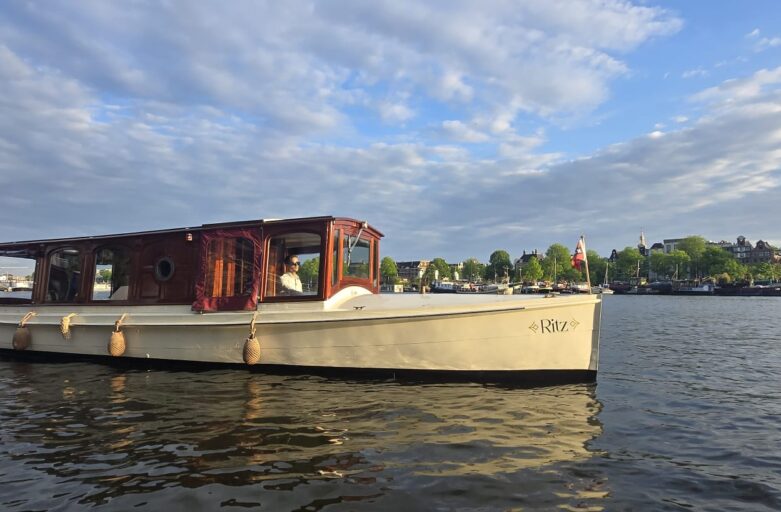
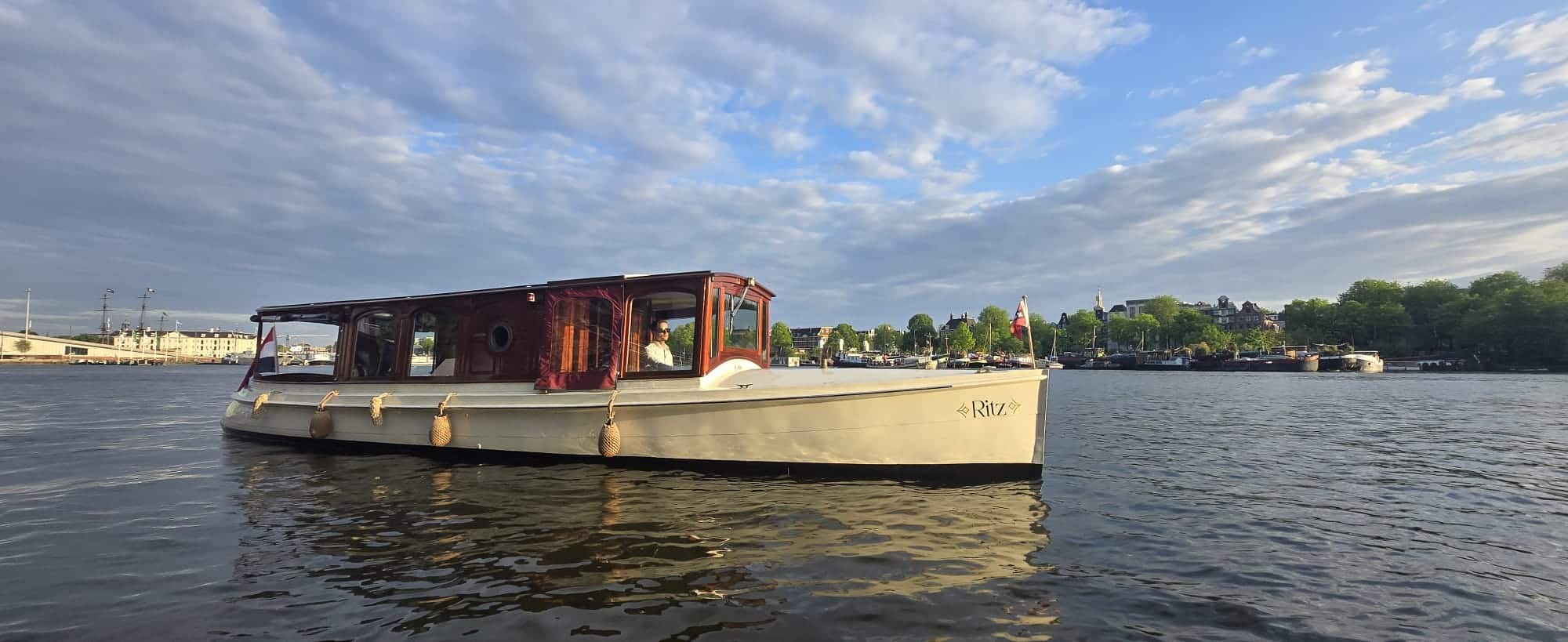
The easiest way to see 750 years of history in a few hours is from a boat. A canal cruise takes you past medieval canals, Golden Age merchant houses, the Skinny Bridge and the warehouses of the old port. On a private boat tour your captain can tell the stories behind the buildings, and our restored historic saloon boats are part of that history themselves: see our fleet.
History of Amsterdam: frequently asked questions
How old is Amsterdam?
The first written mention of the city dates from 1275, so Amsterdam is more than 750 years old. The city celebrated its 750th anniversary in 2025.
Why does Amsterdam have so many canals?
For drainage, defence and transport. The oldest canals were moats around the medieval town; the canal ring of the 17th century was built to expand the city and let goods be delivered by boat to merchants’ houses.
What was the Dutch Golden Age?
The 17th century, when trade, science and art flourished in the Dutch Republic and Amsterdam was one of the richest cities in the world.
Where can I learn more about Amsterdam’s history?
The Amsterdam Museum, the Rijksmuseum, the Maritime Museum and the Anne Frank House each cover a different part of the city’s story.