

How deep are the canals in Amsterdam?
The canals in Amsterdam are around 2.5 metres deep. The Amstel river is 3m metres deep. The Amstel is the only river in Amsterdam – the rest is all canals.

How many canals does Amsterdam have?
Amsterdam has in total 165 canals. With a private boat you can explore even the narrow canals of Amsterdam.
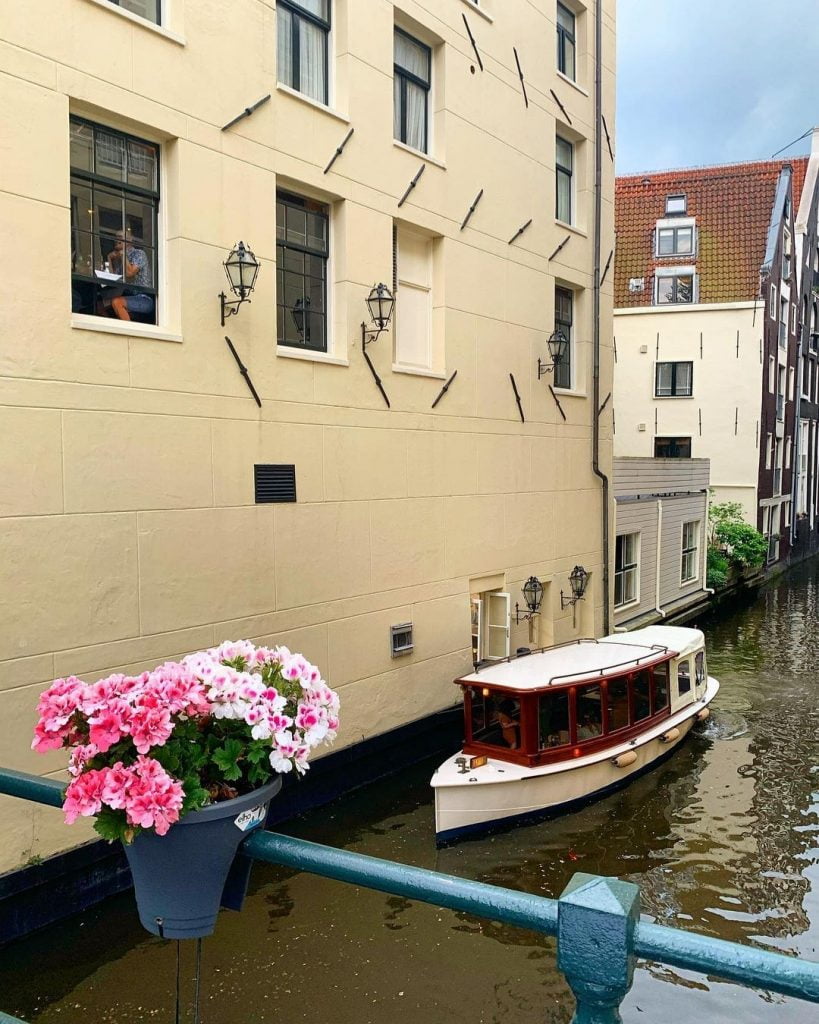
Can you swim in Amsterdam canals?
Officially you are not allowed to swim in the city canals due to safety reasons (boat traffic). However, there are designated public swim areas where swimming is officially allowed! The water quality is good enough for swimming.
Are there fish in Amsterdam canals?
Yes there are plenty of different fish in the Amsterdam canals. The fish that can be found in the canals are: perch, pike, zander, and roach. The water quality is surprisingly good as all the houseboats are required by law to be connected to the suage system. However, you can’t see the fish as the swampy ground makes the canal water reflect and perceived as “dirty”. But as said, its just optical and the water quality is fish friendly. Please note fishing is not allowed without special permission and not recommended.
How many people fall in the canals in Amsterdam?
Around 20 people fall in the canals in Amsterdam every year. Mostly it happens to tourists being under influence or sometimes also homeless people that fall in at night. In the winter this is very dangerous as you will undercool very quickly.
Are the Amsterdam canals man made?
The Amsterdam canals are man made. They were made for the drainage of the water as the Netherlands is below sea level.
Do the Amsterdam canals freeze over?
The Amsterdam canals freeze over sometimes. In the past it happened much more often, but when it happens the locals enjoy ice skating on the canals a lot!
Can you drink Amsterdam canal water?
Amsterdam canal water is not drinkable. Even though it is much clearer then it look like, its not for consumption.
Which city has more canals Venice or Amsterdam?
Amsterdam city has nearly twice as many canals then Venice and is therefore also called the Venice of the North.
How many bikes fall into Amsterdam canals?
Around 13.000 bikes fall into Amsterdam canals per year.
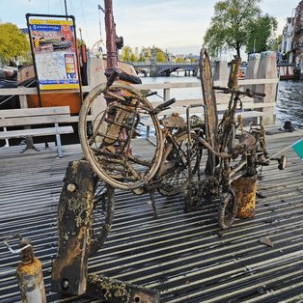
Why are there so many bikes in the canals of Amsterdam?
There are many bikes in the canals of Amsterdam due to vandalism or abandoned bikes that fall in. The city of Amsterdam cleans up to canals frequently where they fish out old roasty bikes.
Do people skate on the canals in Amsterdam?
When the canals are frozen, Amsterdam locals love to go ice skating on them.
How were the Amsterdam canals built?
Construction began in the Middle Ages for defense and water management, with early moats dug around the 12th-13th centuries near the Amstel River. The major expansion occurred during the 17th-century Dutch Golden Age, starting in 1613: the three main semicircular canals (Herengracht, Keizersgracht, and Prinsengracht) were excavated over a period of 50 years to accommodate booming trade and population growth.
Are the canals in Amsterdam fresh or saltwater?
Primarily fresh water, sourced from the Amstel River and IJsselmeer lake, but some areas can be brackish due to tidal influences from the North Sea via locks.
How many canals and bridges are there in Amsterdam?
Amsterdam has 165 canals forming about 90 islands, connected by around 1,500-1,700 bridges (more than Venice).
Are the canals used for moving goods?
Historically vital for trade during the Golden Age, they’re now used mainly for tourism and limited local transportation. Some goods are still moved by barge to reduce road congestion and emissions.
Does Amsterdam use canals for transportation?
Yes, mainly for passenger ferries (free across the IJ River to Amsterdam Noord) and tourist cruises. Although there is no widespread public transit, historic water buses and modern eco-boats offer scenic options. Canals reduce overall road use.
How long are the Amsterdam canals?
The total length is over 100 km (about 62 miles), with the longest individual canal (Singelgracht) at 6.3 km.
Is a canal tour a good way to see Amsterdam?
Absolutely, you can take an open boat tour in summer and a saloon boat tour in winter. While exploring the Amsterdam canals, an expert guide shares the city’s history as you pass by its historic sites.
What to feed ducks and swans?
You can offer seeds, oats, sweetcorn, lettuce, peas, grapes (halved), or floating duck pellets. Please skip bread —it harms digestion and pollutes water. ”
How many cars fall into the canals?
About 35 vehicles per year, often due to parking errors or accidents.
Do canal tour boats have washrooms?
Most standard and larger boats do, especially those serving drinks or lasting over an hour. The Ritz has washrooms onboard, a capacity of up to 12 persons, and facilities for dinner.
